
Brad W.Google review
★★★★★
Kenny and his crew showed up on time and did exactly what they said they would do. They left the area spotless like new. Great prices and very dependable.
For the big tree you would rather keep. Cabling and bracing add support to a weak fork, a heavy limb, or a split trunk so a sound tree has a better chance of making it through the next storm.
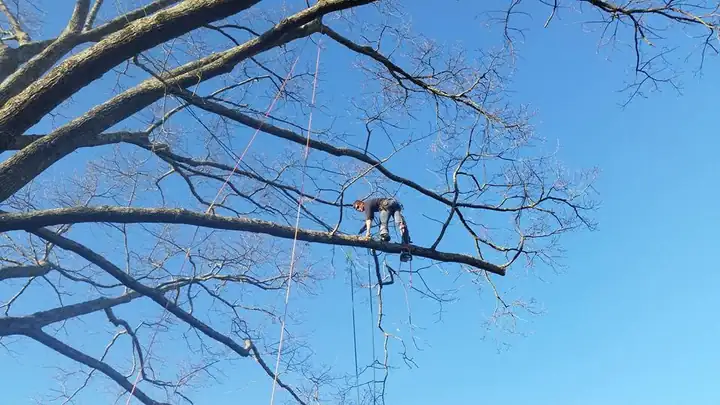
A mature oak with a tight V-shaped fork can look solid for years and then split in one storm. Add the weight of summer leaves, a heavy rain, or ice, and one side tears away. Cabling and bracing add support to that weak point so the stems or limbs move together instead of pulling apart.
Cabling and bracing is on the K&M list of services, alongside hazard assessment and tree health assessment. Not every tree is a candidate. A healthy tree with a structural weak spot often is. A tree with serious rot, a dead top, or a failing root system usually is not, and removal is the safer call. Owner Kenny Malone personally oversees every job and prefers to see the tree in person before he gives a price.
A tree company that also does removals has no reason to oversell a support system on a tree that should come down, and no reason to remove a tree that only needs support. You get the full range of options from one estimate.
K&M has served the Birmingham area for over 30 years and is licensed, bonded, and insured, with coverage up to $1 million in property damage liability. Brad W. wrote that Kenny and his crew showed up on time and did exactly what they said they would do.
HomeAdvisor's June 2026 arborist cost guide puts tree cabling at $200 to $400 on average, with small trees around $175 and medium or large trees at $400 or more. LawnStarter's guide lists $150 to $450 per tree, depending on the size of the tree and how many cables it needs.
What moves the price: the size and height of the tree, how many cables or rods it needs, access, and whether trimming is part of the job. Compared with removing a large tree near a house, support is often the cheaper option, when the tree is a good candidate. See the pricing guide for removal costs. The estimate is free.
Cabling runs a steel cable between two stems or limbs, high in the canopy, so they share the load and cannot spread far apart in the wind.
Bracing uses threaded steel rods through a weak or split fork or trunk, lower in the tree, to hold the wood together.
They are often used together: rods at the weak spot and a cable above it. Neither one is a guarantee. They lower the risk of failure on a sound tree, and the hardware has to be checked as the tree grows.
Good candidates: a healthy tree with a V-shaped fork between two trunks, a long heavy limb over the house or driveway, or a fresh crack in otherwise sound wood.
Poor candidates: a tree with major decay, a hollow trunk, a dead or dying crown, roots lifting out of the ground, or a trunk that has suddenly started to lean. Those point to dangerous tree removal, not support.
If you are not sure which one you have, a tree hazard assessment is the place to start.
K&M is based in Columbiana and handles cabling and bracing across Birmingham, Mountain Brook, Vestavia Hills, Homewood, Hoover, Pelham, Alabaster, Helena, Chelsea, Columbiana, and Calera, plus the rest of Central Alabama.
4.7 stars from 85 Google reviews. Read more reviews.
Kenny and his crew showed up on time and did exactly what they said they would do. They left the area spotless like new. Great prices and very dependable.
K&M came out same day and took down some very large and potentially hazardous pines that were leaning towards my house.
I have been using K&M for several years. Prices are good, crew is great and they always clean up. They take care of my property like it's theirs.
We have been doing business with K&M for some 20 years. They have always been responsive, reliable and fair.
Great guys to work with, showed up when they said they would and cleaned up so well you couldn't tell they were there.
Had a tree covered in vines with power lines running through it. Trimmed and took it down perfectly.
On the right tree, yes. A healthy, valuable tree with a weak fork or a heavy limb can often be supported for far less than the cost of removing it. On a tree with serious decay or root problems, cabling only delays the inevitable, and removal is the better use of your money.
HomeAdvisor puts tree cabling at $200 to $400 on average, about $175 for a small tree and $400 or more for a medium or large one. LawnStarter lists $150 to $450 per tree. The size of the tree and the number of cables make the biggest difference.
The hardware can last many years, but the tree keeps growing around it and moving in the wind, so it wears. Arborilogical recommends inspecting cabling and bracing hardware every year, and it should also be checked after a major storm.
Bracing uses threaded steel rods installed through a weak or split fork or trunk to hold the wood together. It is usually done lower in the tree than cabling, and the two are often used together.
It is not a DIY job. Cables are installed high in the canopy, which means climbing or lift work, and bracing means drilling through the tree. Poorly installed hardware can damage the tree and give you a false sense of security.
If the split is fresh and the wood is sound, rods through the split and a cable above it can hold the two halves together. If the split is old, wide, or full of rot, bracing will not hold, and the tree usually has to come down. Keep people and cars out from under it until it has been looked at.
Sometimes. A recent split in healthy wood can often be braced and the tree can live on for years. A split that has decay inside it, or that runs down to the base, is much harder to save.
Co-dominant stems, or a co-dominant fork. Two trunks of about the same size grow side by side from one point, often with bark trapped in the V between them, which makes the joint weak. It is one of the most common reasons trees are cabled.
Cables and rods support forks and limbs. They are not meant to hold up a large tree that is leaning from the base. A big tree that has started to lean recently, especially with soil cracking or lifting on one side, is a hazard and should be looked at right away. See dangerous tree removal.
Stakes and posts are for young, newly planted trees, using soft, wide ties that will not cut into the bark. They should come off once the roots take hold, usually within about a year. A mature tree cannot be held up with a post.
Bracing and some cable systems require drilling, which makes small wounds that a healthy tree can close over. Other cable systems wrap around the limbs instead. Either way, the support has to be sized and placed correctly, or it can do more harm than good.
It lowers the risk on a sound tree, but it is not a guarantee. A tree can still fail at the roots, in a different limb, or in severe wind.
Cabling is used mostly on hardwoods, like oaks, that grow co-dominant forks and long spreading limbs. Pines, the most common trees in Alabama, usually grow a single straight trunk, and a pine with a structural problem is more often a removal candidate. Ask on the estimate.
HomeGuide puts removal of a tree under 30 feet at about $150 to $500 nationally, and ProMatcher lists $351 to $435 in Alabama. Larger trees, trees near the house, and hard access cost more. See the pricing guide.
In general, your homeowners insurance covers damage to your house, even if the tree was your neighbor's. If a neighbor knew the tree was dead or dangerous and did nothing, that can change things. Check your policy and talk to your agent. This is general information, not legal advice. See storm damage tree cleanup.
Yes. Tree removal, dangerous tree removal, and stump grinding are all K&M services. See tree removal.
K&M works across these towns. Tap yours for local details.
Free estimates. 24 hour storm service.